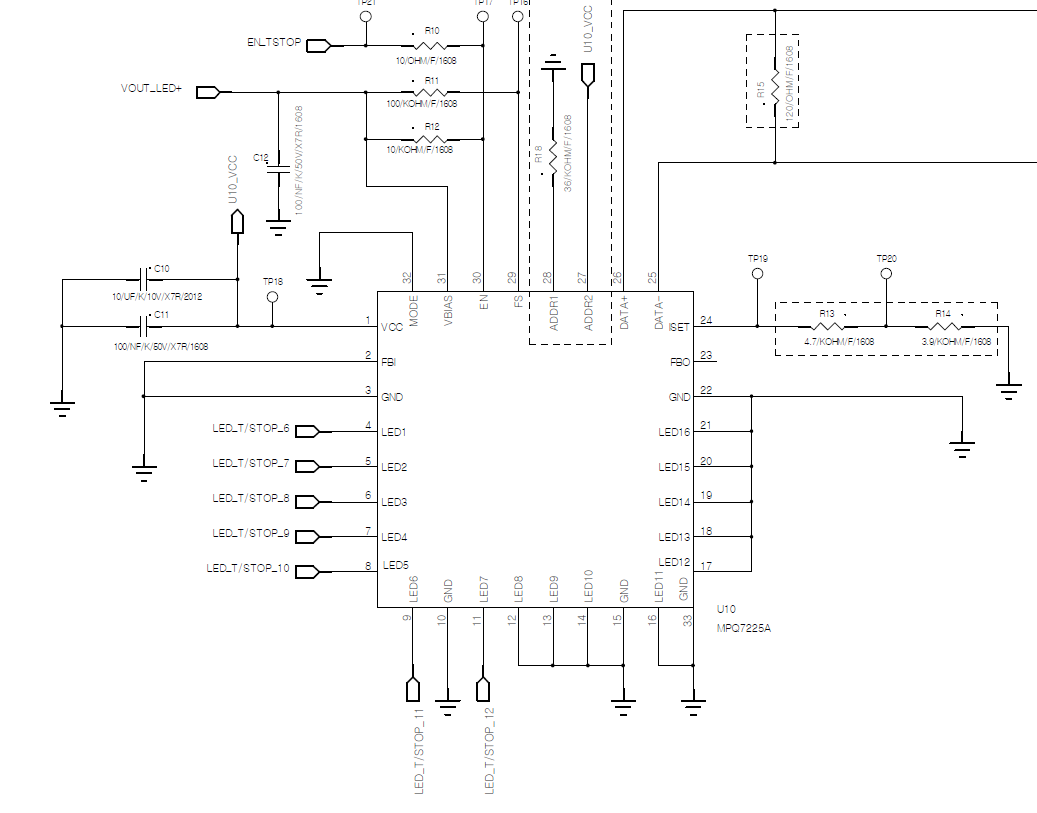
I am using the MPQ7225A and controlling all LEDs on all channels by controlling channel 1 using the Global Dimming method.
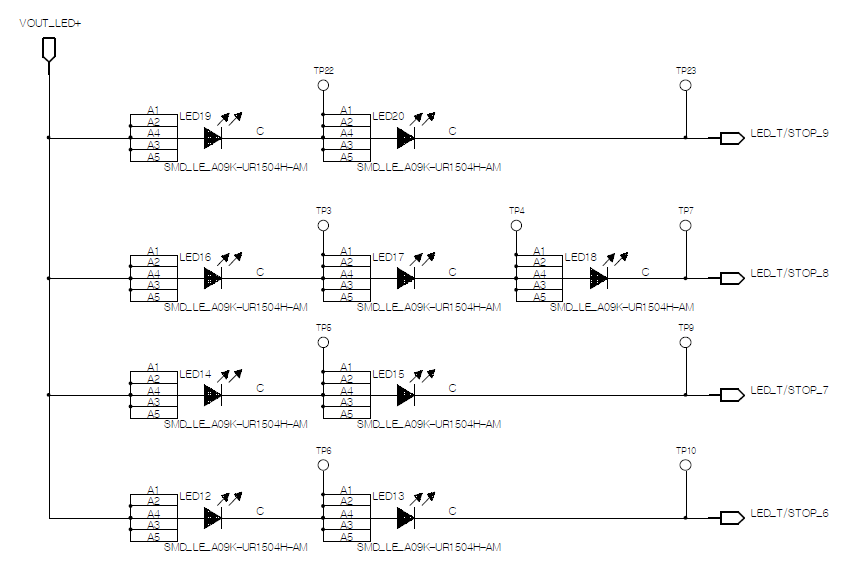
Three LEDs are connected in series on channel 1, and two identical LEDs are connected in series on channel 2.
When in operation, the channel with 3 LEDs is bright and the channel with 2 LEDs is dark.
VBIAS is 6.95V and ISET is 8.6Kohm.
What could be the causes?
A fault signal is detected; based on a channel with three LEDs connected in series, is it recognizing one LED as short-circuited in a channel with two LEDs connected in series?
Added circuit photos since there were no replies. In the schematics, each channel on a single IC is set up with a different number of LEDs.
A fault signal keeps popping up in this setup. Could someone point out what might be wrong here?
Hi,
Thank you for the question and for the schematic. Your suspicion is correct.
The MPQ7225’s per-channel open-LED protection asserts when VLEDx < 100 mV for 3.6–4.4 ms, latching the channel off and pulling /FS low. It has no “LED count” awareness, it only looks at the cathode voltage on that channel. In your setup:
-
Channel 1 (3 LEDs): The cathode sits at roughly 3 × V_F above VBIAS rail.
-
Channel 2 (2 LEDs): The cathode sits roughly one V_F higher. During the PWM on-time the part sees a voltage profile it does not expect for a fully-loaded string, and the protection logic interprets the difference as a fault, latching the channel.
This is not a global-dimming issue; global dimming only scales duty on channels 2–16 from channel 1. The mismatch is purely the string voltage the protection logic expects.
Fix:
-
Use the same number of series LEDs on every channel of a single MPQ7225. If you need a 2-LED group, assign it to a separate IC or a separate ISET group.
-
If for layout reasons you must keep them on one part, set LATCH_EN = 0 so the part hiccup-resets instead of latching, and verify your buck output gives the 3-LED string its 3 × V_F + ~300 mV. The 2-LED channel should then at least recover cycle-to-cycle rather than staying dark.
-
Read the fail-safe register after a trip to confirm which CHx bit (open vs. short) is set, that will validate the diagnosis above.
The short-to-GND /open detection thresholds in the spec are designed for a uniform string, mixing counts puts a channel outside that window.
Thanks,
Mason