my question is about the maximum voltage admitted on input pin EN/SYNC of MP9943GQ.
In the datasheet is show an absolute maximum rating of 6V and if higher then input current has to be limited to 0.15mA maximum using a resistor.
In case EN/SYNC pin get an applied voltage higher than 6V (for example 13V), without a current limitation, the pin EN/SYNC could be damaged and MP9943GQ could be disabled (turn off)?
Thanks for reaching out on the MPS Technical Forum!
It is not recommended to apply a voltage greater than 6V without a pullup resistor, as it could damage the internal Zener diode due to high current. If you plan on connecting the EN/SYNC pin to a rail which is greater than 6V, a pullup resistor is required.
With 13V connected to VIN, RPULLUP ≥ (13V – 6.5V) ÷ 150µA = 43.3kΩ.
Please feel free to reach out if you have any additional questions!
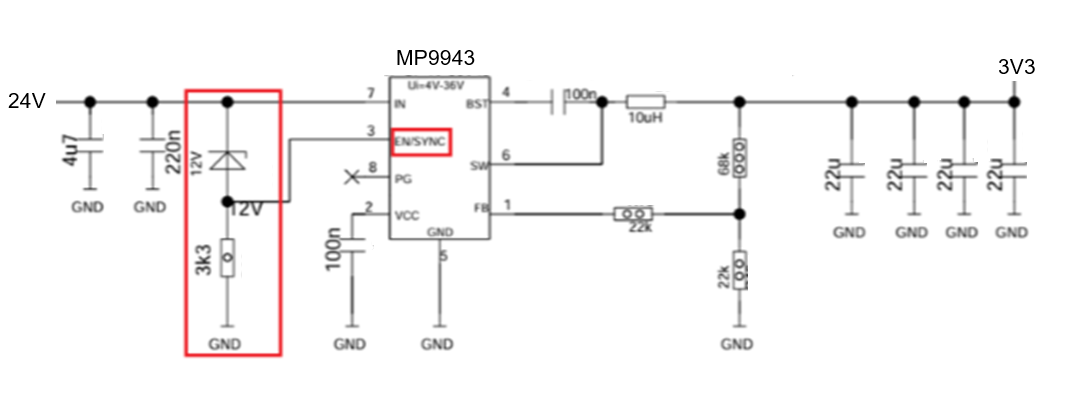
I have two more question, see circuit below that looks like not correct related to the voltage on the EN/SYNC pin.
EN/SYNC pin is connected to 24V using a 12V Zener diode type BZX84C-12V. The current in the 12V Zener is limited by the 3K3 resistor connected between EN/SYNC and GND.
In this circuit EN/SYNC reach 24V - 12V = 12V typical and theatrically the MP9943 get damaged as EN/SYNC rise over 6V and there is no resistor connected from EN/SYNC to 24V. In fact the Zener should replaced by a resistor so to have EN/SYNC voltage less than 6V or to llimit the EN/SYNC input current < 0.15mA.
In order to prevent damage to the internal Zener diode, you must limit the input voltage to <6V or add a pull-up resistor to limit input current. The circuit you provided will most likely break down as the en/sync pin is connected to a voltage >6V and does not have current regulation.
Looking at your setup, I recommend replacing the Zener diode with a resistor as you can create a voltage divider and create a 6V input for the EN/SYNC pin.
I see that your solution has been working for over 5 years now, but it is still highly not recommended to have greater than 6V to the EN/SYNC pin as it could cause damage. Without additional information it is hard to tell why the chip is still working. Continuing to utilize this setup may result in shortened lifespan of the chip.
A design change will ensure that this chip does not face any issues in the long run.