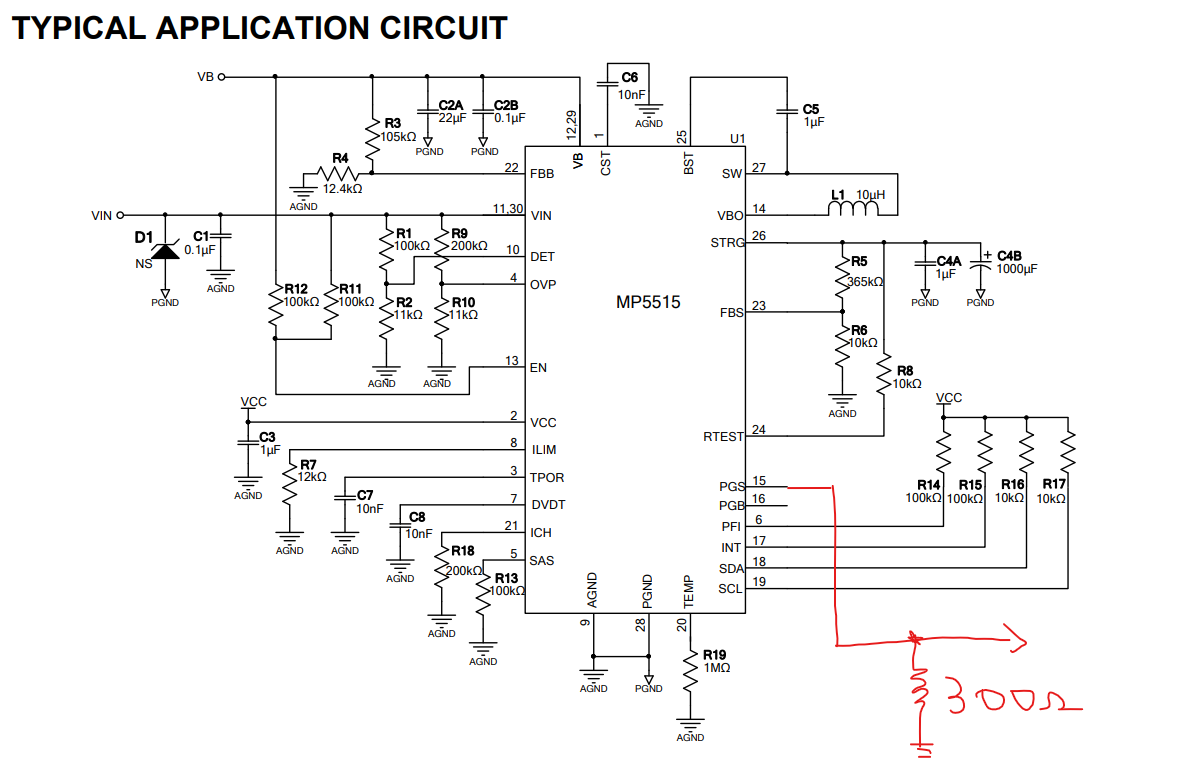
I would like to check whether a 300 Ω pull-down resistor from PGS to GND will impact the RTEST discharge during the 95% PGS threshold test accuracy.
hi MPS FAE team,
Any update on this question?
Hello,
Thank you for your question. Is there a particular reason you are testing with a value of 300 ohms? The maximum current of PGS is only 5mA, which could be problematic for your design. Are you able to increase the resistor to 10k ohms or greater?
Also, please consider running the Cap Test Sequence (register 04h, 06h, 01h as described in page 20 of the datasheet) and comparing the Cap Test Timer register values with and without the pull-down resistor. If the timer values are identical and within the stated accuracy, the pull-down resistor effects are likely to be negligible.
Thanks,
Mason
Thanks @Mason.FAE
We doing some negative validation on this PGS with 300ohm pull down resistor. We found out the CSTRG is lower than we expected. Meaning it have faster discharge time if we used 300ohm pull down resistor
Hi,
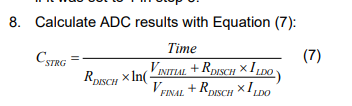
Thanks for the information. During the cap test the cap discharges through RTEST, so your 300 Ω becomes an extra low‑impedance parallel load that Equation 7 doesn’t account for. Resulting in faster discharge, shorter timer, lower C_STRG, exactly what you saw.
Two things to note:
-
300 Ω is below the intended external discharge‑resistor range and may overload the PGS driver (~5 mA). For a clean C_STRG, go ≥1.2 kΩ and re‑run; if the timer matches, the effect is purely that extra parallel load, not a device fault.
-
If the 300 Ω is mandatory for your negative test, treat it as an additional parallel load in the discharge model before solving for C.
Thanks,
Mason