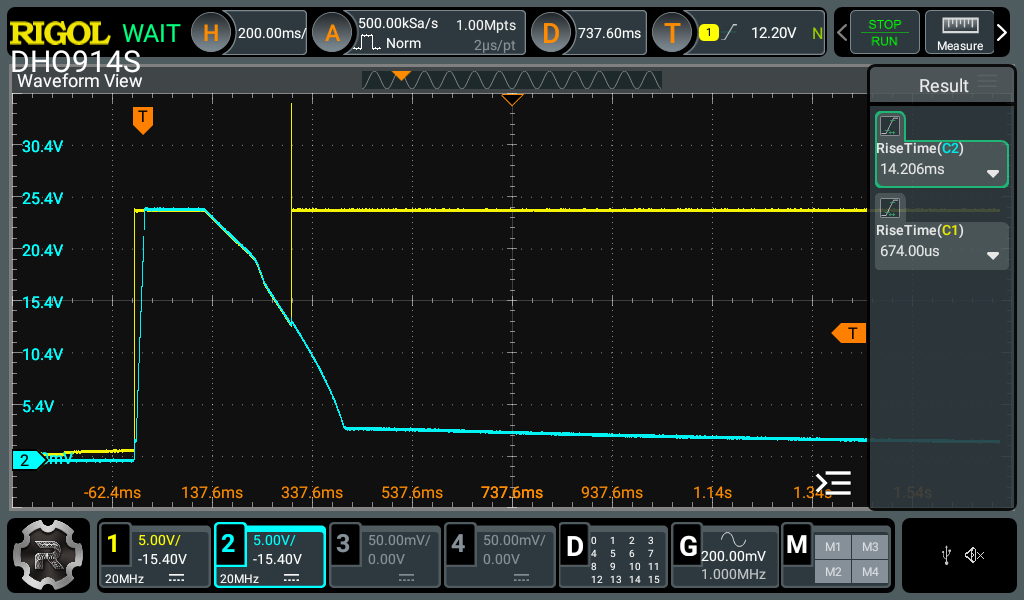
I am running into an issue where the output of the MP5056 gets disabled when the input is re-connected while the output is discharging.
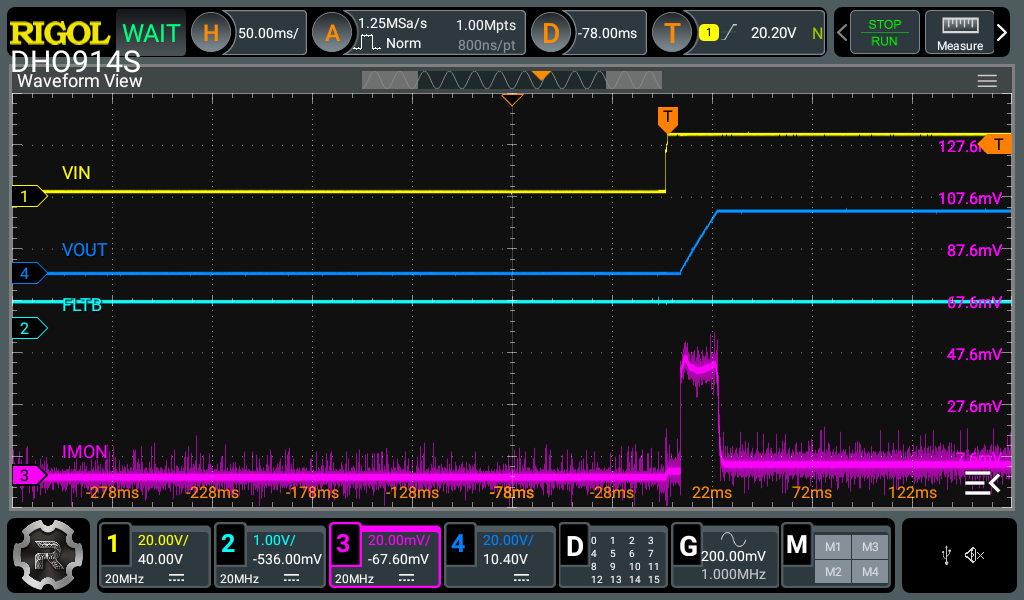
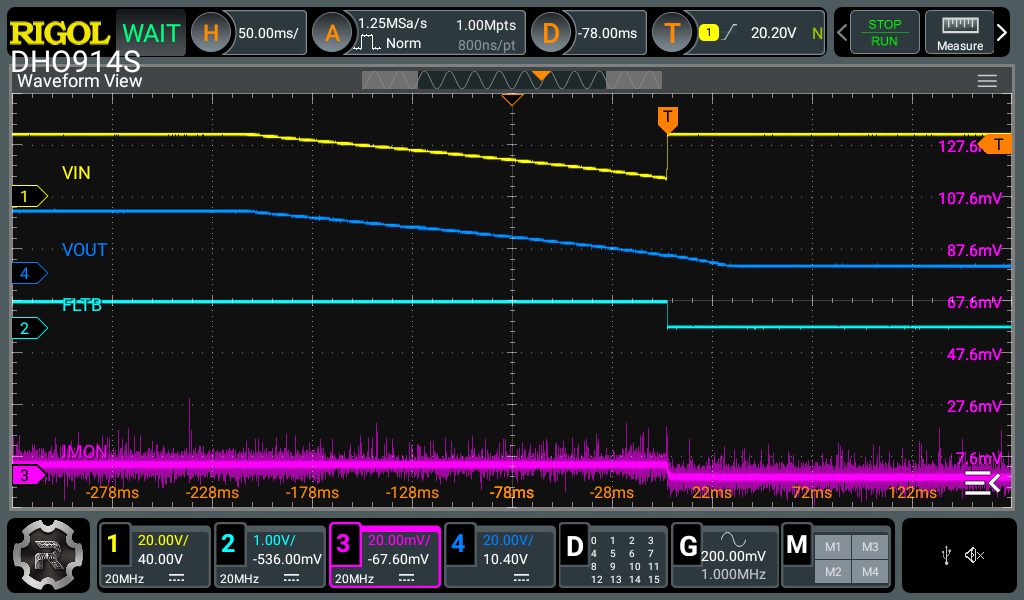
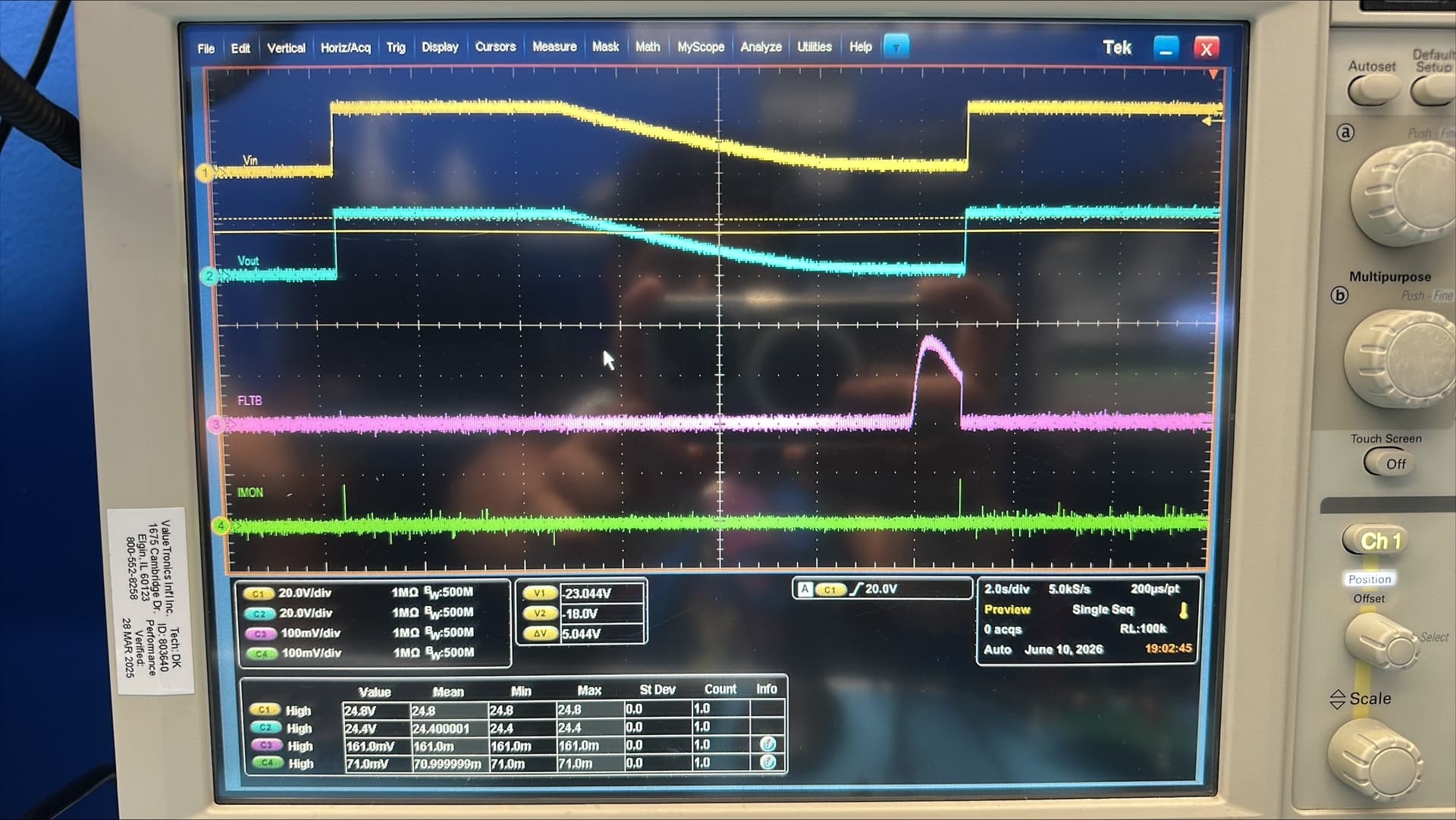
I originally ran into the problem when a long input “bounce” would disable the output but have managed to replicate it by disconnecting power and quickly re-applying power. I have captured the behaviour here where the yellow is VIN and blue is VOUT
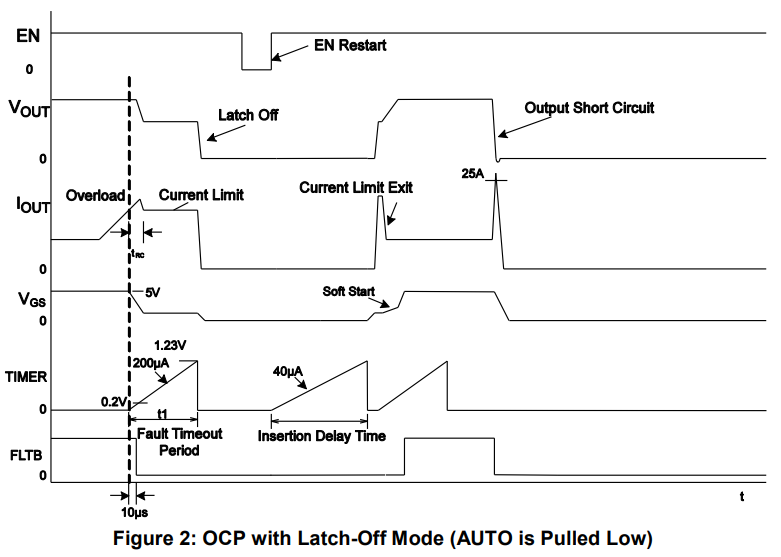
I have it set to not auto-retry on a “fault” but I do not really see this as a fault event, and cannot see anything related to power disconnect behaviour in the datasheet.
The voltages don’t appear to exceed the absolute maximum thresholds of the MP5056.
I am curious about the current in application. What is the load current? In addition, what is the current limit set to? My first inclination is that there could be a current inrush that could be overloading upon start-up.
The current limit is set to 12.5A (10k resistor), and appears to be working correctly as the VOUT rises slower than the VIN. It is only on the rapid disconnect and re-connect that it problem occurs.
The load is approx 500uF of capacitance, with almost no load after the initial inrush.
FLTB is being pulled low but there is no overcurrent event (the capacitive load will still be charged and no current spike shown on IMON). So not sure why this is being treated as a fault.
Interesting. Thanks for providing more waveforms showing this behavior.
The FLTB pin should only be pulled down if an OC Fault occurs or if a thermal shutdown fault occurs. Based on the nature of what is happening, it seems like it would make more sense that we would be experiencing an OC event.
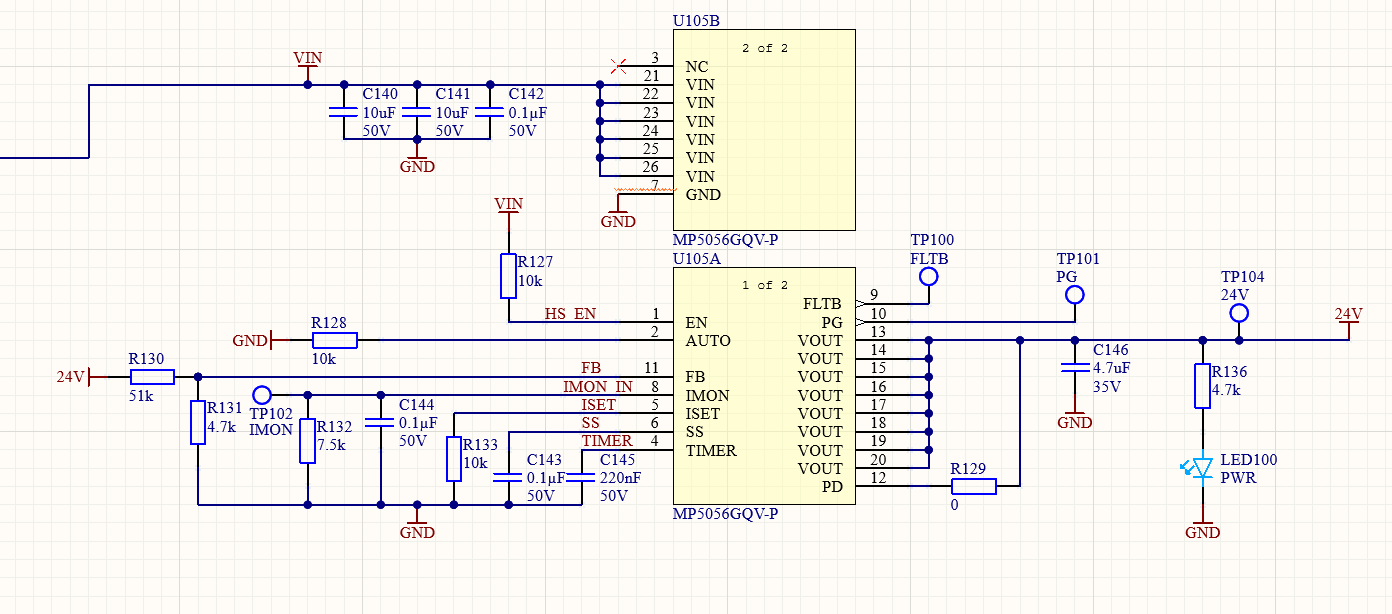
Also to focus more on what could be going wrong, do you have a schematic of the MP5056 with respect to what is happening here?
The behaviour is very repeatable, and only occurs if VIN is re-connected whilst VOUT is discharging. If it is reconnected slightly later after the discharge (when I would expect a larger inrush) it does not cause a fault
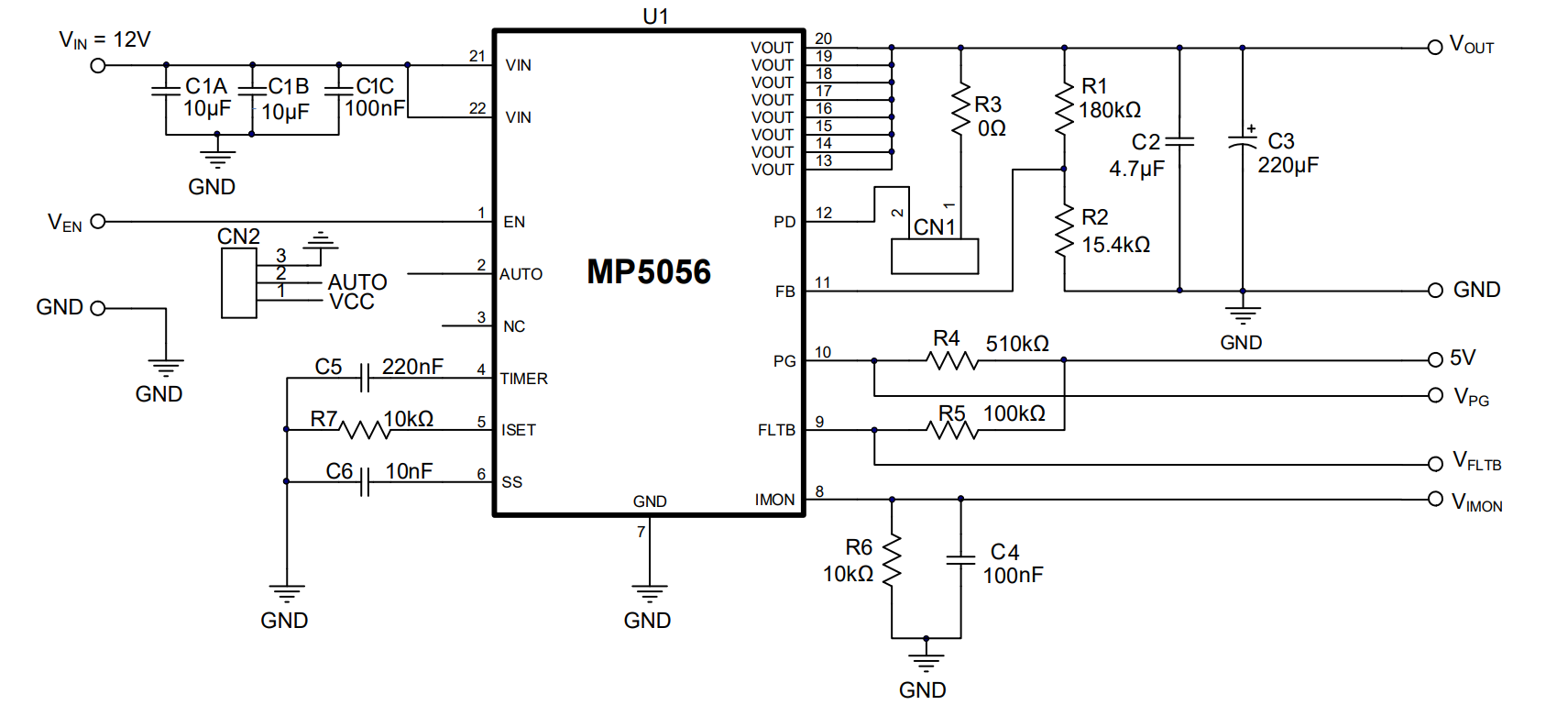
Comparing the typical application to the schematic you provided, there seems to be the following differences:
You only have a 4.7uF capacitance, but however there should be a bigger 220uF capacitor used as well to provide sufficient output capacitance. Be sure these are rated 2-3x 24V as this is the voltage that you have to account for any derating in general.
I don’t see a 100kOhm pull up resistor on the FLTB pin. Is this present somewhere else on this schematic? I just see it connected to TP100.
As of now, the pull-down resistor on the AUTO pin causes the MP5056 to latch off. Would it be better that you have this in auto-reset mode? Does the issue still persist if done so?
Typically, the PG pin is pulled up like the FLTB pin. Perhaps add this if you would like PG functionality since this is connected to TP101.
Hopefully pointing these differences help in solving this issue on your end.
There is already around 500uF of capacitance on the output (not shown on the schematic as it on a different page).
The FLTB pin is not used in the design so is normally left floating. However, this was externally pulled up with a 100k resistor for testing with the previous scope captures. And as they show the issue still occurs.
The device recovers on a retry when in auto-reset mode. However I would like it to latch off for my application, so not really a suitable fix unfortunately.
PG functionality is not needed in this design so it is left floating.
Are you able to try and replicate this issue on a development board on your end?
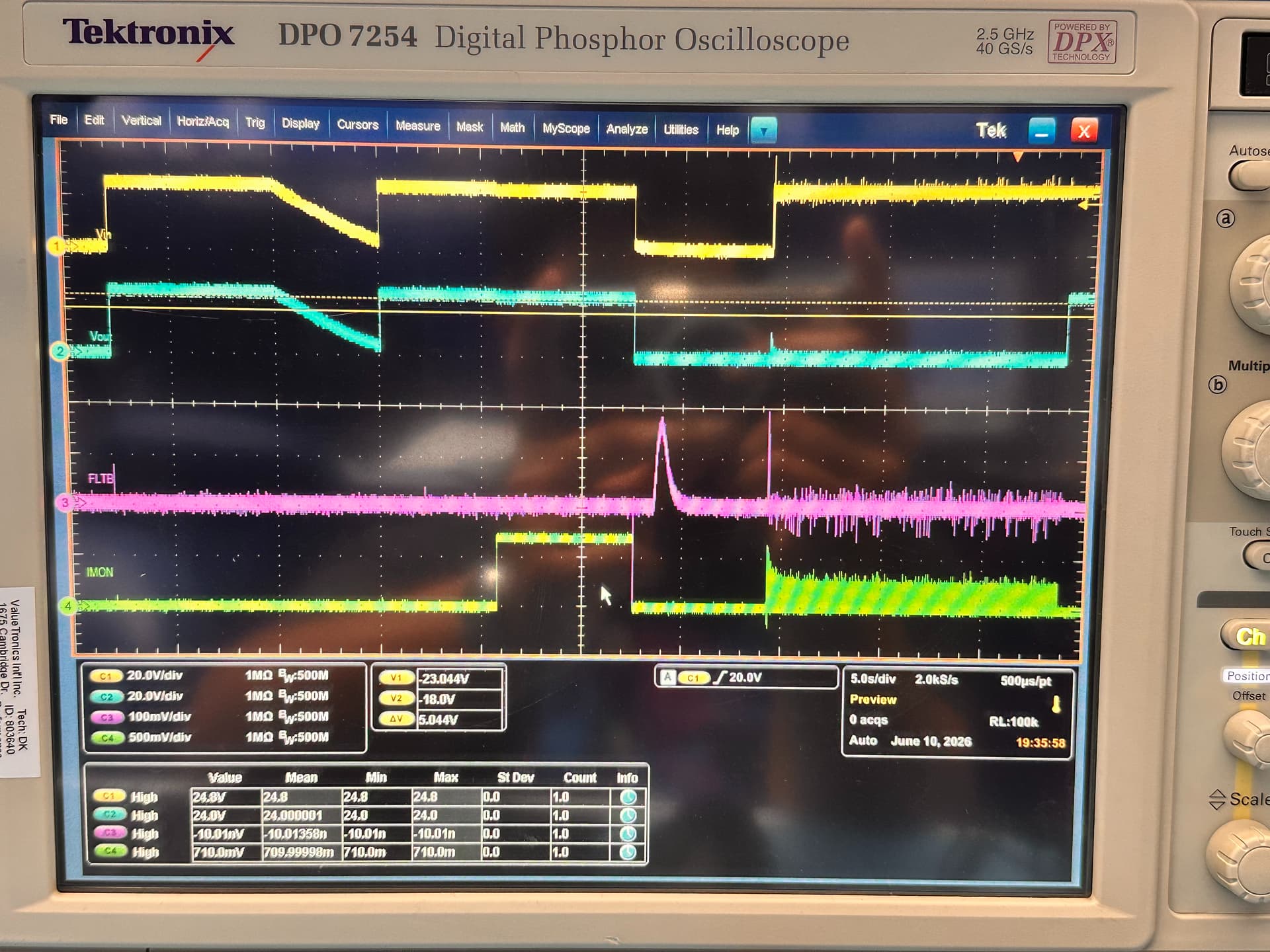
I was able to test and replicate what you had seen in the lab.
For reference, Yellow = Vin, Blue = Vout, Pink = FLTB, and Green = IMON in case those labels on the scope are hard to see.
This test was repeated where I unplugged the MP5056 in the unloaded case and Vout recovered as before. I added a load of ~7A and unplugged Vin again. Vout did not recover until I took away the load.
I have yet to discuss this with my AE colleagues, but this means that this can be replicated on a verified design, validating your schematic further.
You’ll hear back from me after I discuss with colleagues.
In application for this particular case, it may be best that you have a mechanism that disables the load such that the part can start back up again. I have yet to get a conclusive answer from the AEs that specialize with this part but will update you once they get back to me.
In the scope capture I provided there is very little load on the output (around 8mV on IMON) and the issue is still happening so I do not think it is necessarily caused by a high load.
If there is a way that you can disable the load when this occurs in application and power cycle the E-Fuse, this would allow the part to function properly.