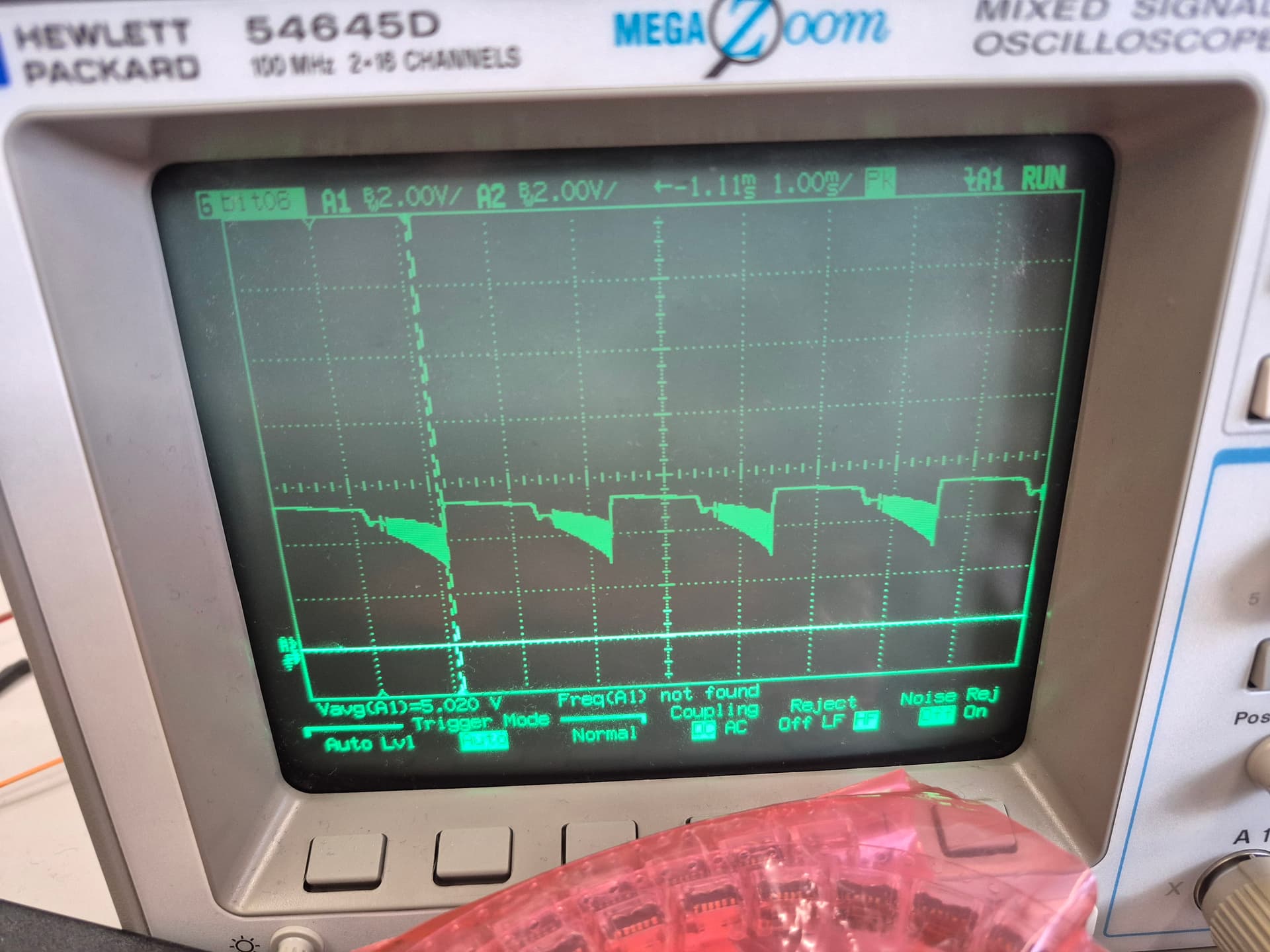
Seeing something strange that I cannot figure out. When charging 2S battery that is at around 7.6V the VBUS voltage is dropping sharply from 5V down to about 3V and then recovering. The period is about 2.4ms. I have setup a VMIN of 2V via RH and RL for this measurement. I measured a resistance from USB cable to VBUS node near the MP2672 via testpoint and stripped USB cable of about 0.5ohm (but I suspect my Fluke has about this resistance since when I short the probes I get about 0.3ohm. My ISET resistor is 8.2kOhm programming about 1.5A charge current.
The strange thing is that on this PCB, I purposely made the VBUS traces extra wide, and I resoldered the USB plug to be sure it was not the problem.
Here is scope trace of VBUS measured on the PCB that is connected to VIN.
I do not observe this oscillation on the previous PCB, which correctly reaches a stable charge current of about 2.5A with exactly the same battery and charge level and VBUS dropping to about 4.3V with this charge current.
Any ideas? I have triple checked component values, NTC voltage (VDD_LDO/2), VMIN, and other components. I took off original MP2672 and carefully soldered a replacement, checking all the solder joints with microscope and they all look clean, rising up the sides of the package over the package pins. I soldered a replacement USB plug as well.
Hello, apologies for the delayed response here. I have several questions to further evaluate the situation:
So just to get this straight, you had a previous revision of this PCB with the same schematic where the only difference between each PCB is that you had made the VBUS traces wider than they were?
And you didn’t see these issues on the previous PCB? Were there any other differences in the previous layout?
What was the motivation for expanding these traces?
I can only assume that the new components that you replaced on the newer PCB revision still exhibit the same oscillatory behavior, correct?
Have you considered reverting your schematic on the old PCB design (assuming this didn’t exhibit the behavior you were seeing on the scope)?
Since it has been more than 2 weeks since your last initial post on this issue, do let us know if there have been any updates.
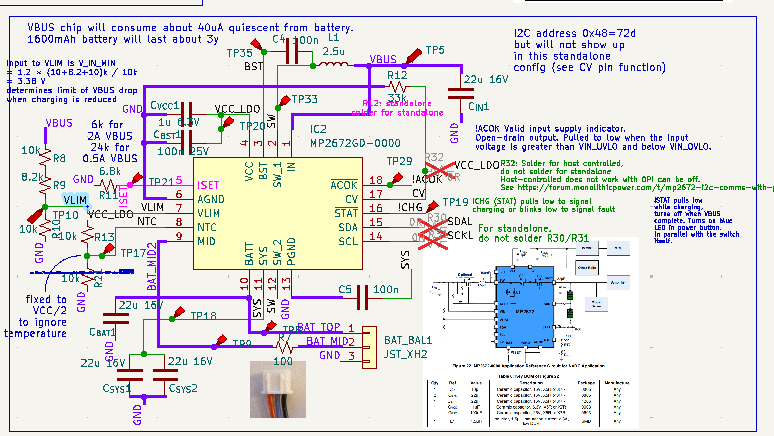
In addition to the questions here, do you have a reference schematic and layout comparisons between the old and new PCBs here? Let me know on these items when you can.
Thanks for ping back Krishan. I have a new PCB rev back and will report as soon as I get a new battery to test with it (I ran previous battery down to 2V and destroyed it…).
The main symptom I see now is periodic (2ms interval) pull downs of VBUS. In each cycle, VBUS starts at 5V and then is pulled rapidly down to <3V (but still higher than VLIM). I can see this right at the PCB entry of VBUS. This suggests that the MP2672 is pulling a massive current from VBUS. I was using an 8.2kOhm R_ISET. I have changed this now to 22kOhm to test if it is some effect of large charging current but need to wait for new battery. My USB power supply is high quality so I don’t think that is the problem. I have also tried multiple USB cables. Will report next results ASAP.
One thing I know for sure: My 3-wire charger extension cable was bad. When I connected directly to battery (after changing to 18kOhm R_ISET), I saw USB current about 0.8A. So the symptoms were at least partly from something wrong in cable, perhaps either ground or vmid were open.
And very strangely, after cable fix, with 6.8kOhm and 10kOhm R_ISET, I saw the same VBUS drooping and average USB current <0.5A. But with 27kOhm, I saw stable VBUS and USB current about 1.1A. I don’t get it.
Just a quick update, I put a resistor substitution box insread of R_ISET (R11 in schematic below) and found that when I went from 33k to 22k, all of a sudden the charge current reduced because VBUS was dropping down and turning off the charging every 2ms as in my scope trace above. With 33kohm, the charge current was around 1A. The value just does not make sense, the current is too large for this R_ISET and making R_ISET smaller does not increase the current.
Apologies I didn’t get back to these updates you had provided regarding the R_ISET resistor. It is odd that the charge current that you get is too large for the R_ISET value and making that resistor value smaller doesn’t change the charge current.
Perhaps it would be best for you to submit a ticket regarding this situation as you would receive faster and more direct support regarding this issue you have been going through: