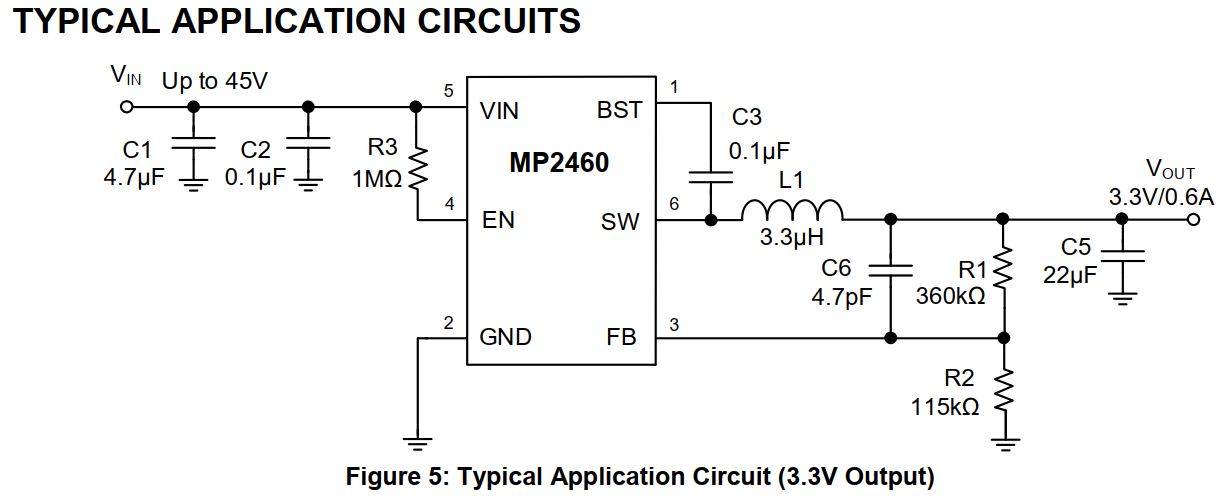
what happen if R1 and R2 change to 18k ohm and 5.1k ohm? is it OK?
target output is 3.6V
Hello @xbnarisx
Thank you for posting your question on the MPS Technical Forum.
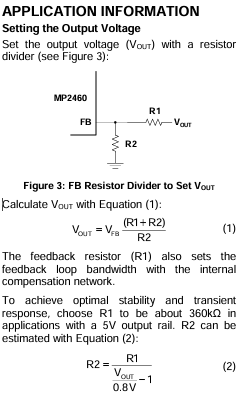
From our datasheet, under the setting output voltage section, it recommends to use R1 of 360kΩ for optimal stability and transient response. Although it does not necessarily means that you cannot change R1 value, it will ultimately depends on your application.
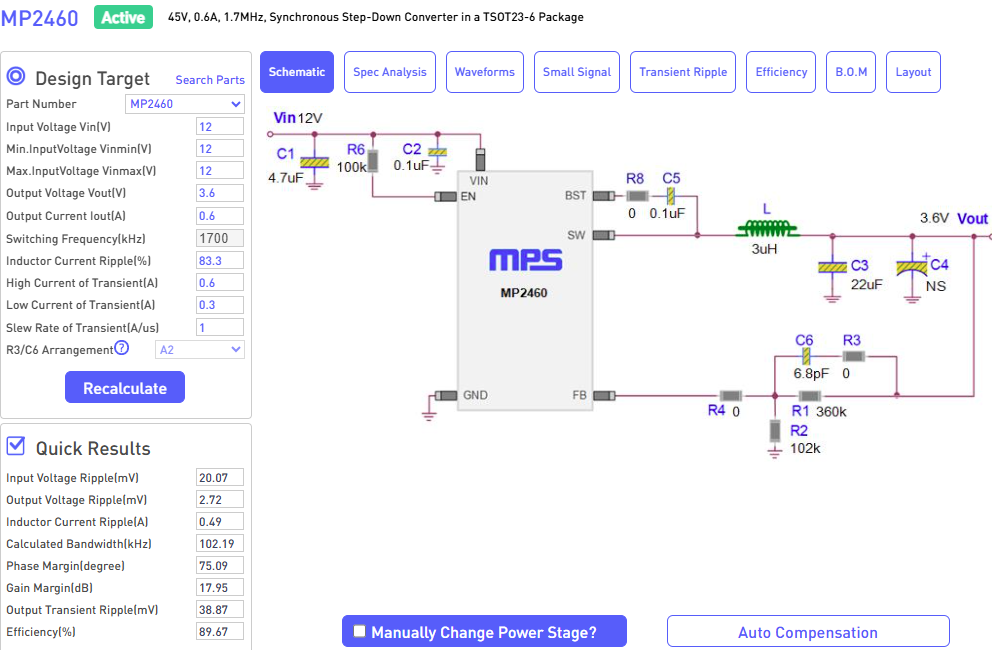
We can use our DC-DC designer tool see what would happen if you decide to use your specified values for feedback loop. Assuming: Vin =12V, Vout = 3.6V, Iout = 0.6A.
By selecting R1 = 360kΩ, and R2 = 102kΩ, the system yields a gain margin of 17.95dB, and a phase margin of 75.09deg.
By selecting R1 = 18kΩ, and R2 = 5.1kΩ, the system yields a gain margin of 22.58dB, and a phase margin of 34.94deg.
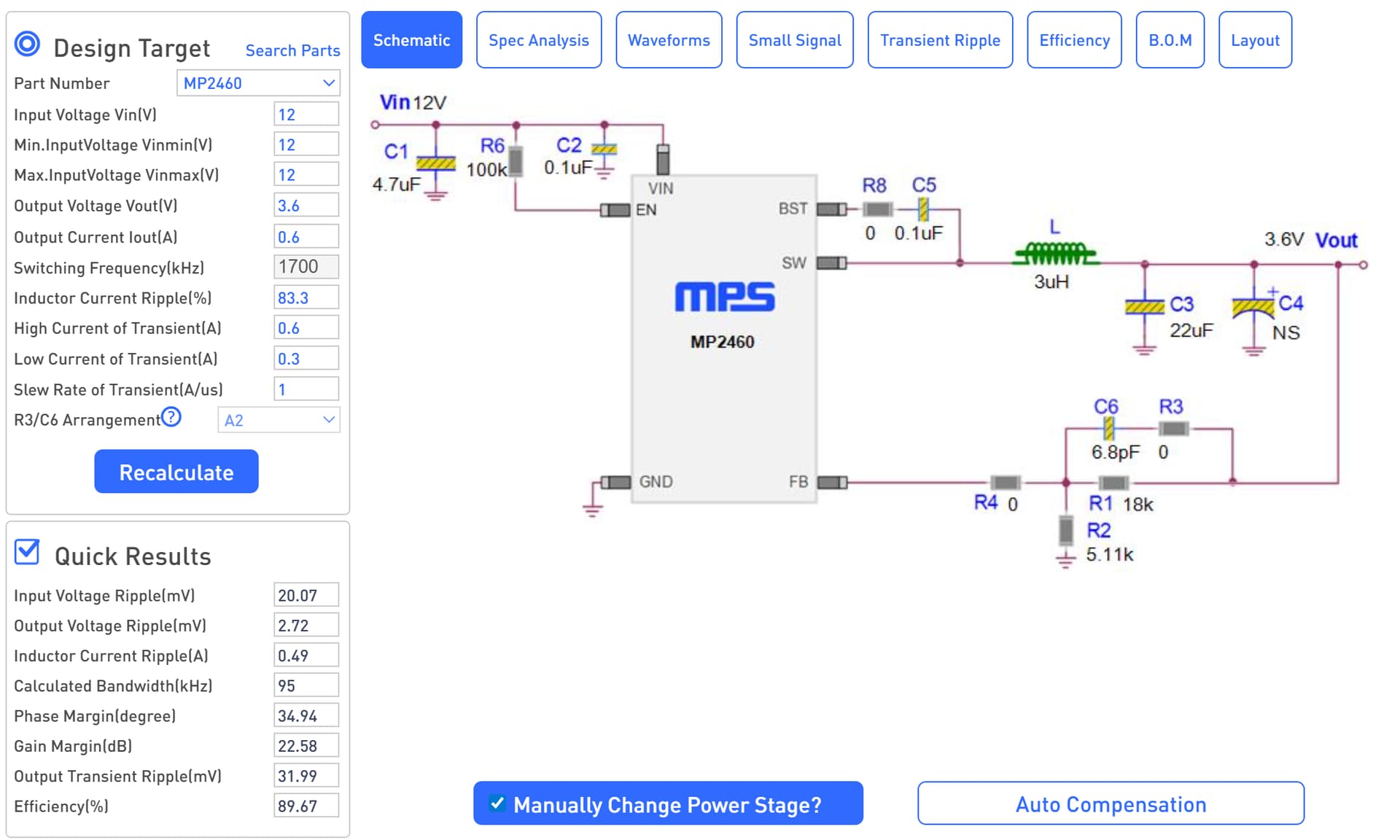
Clearly the biggest difference is in the Phase Margin for both scenarios. By using your chosen Resistor values, your system is less robust and it’s more susceptible to ringing during a transient response, compared if using higher feedback resistor values
I hope this give you some insight and clarification.
Best,
Edgar
Thank you so much for the explanation.
I have another question, what if EN not connected to VIN.
does it affected to the voltage of VIN?
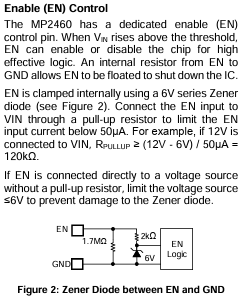
It is totally fine if EN pin is not connected to VIN, it will not affect the voltage of VIN nor the performance of the device.
You could have the EN pin connected to an external voltage source if desired, but just make sure to add a pull-up resistor to limit the amount of current going into de EN pin.
Also you could connected directly without a pull-up resistor, but you need to make sure the voltage does not exceed 6V.
Here is the section on the datasheet regarding the EN pin for further reference.
Best,
Edgar
This topic was automatically closed 90 days after the last reply. New replies are no longer allowed.