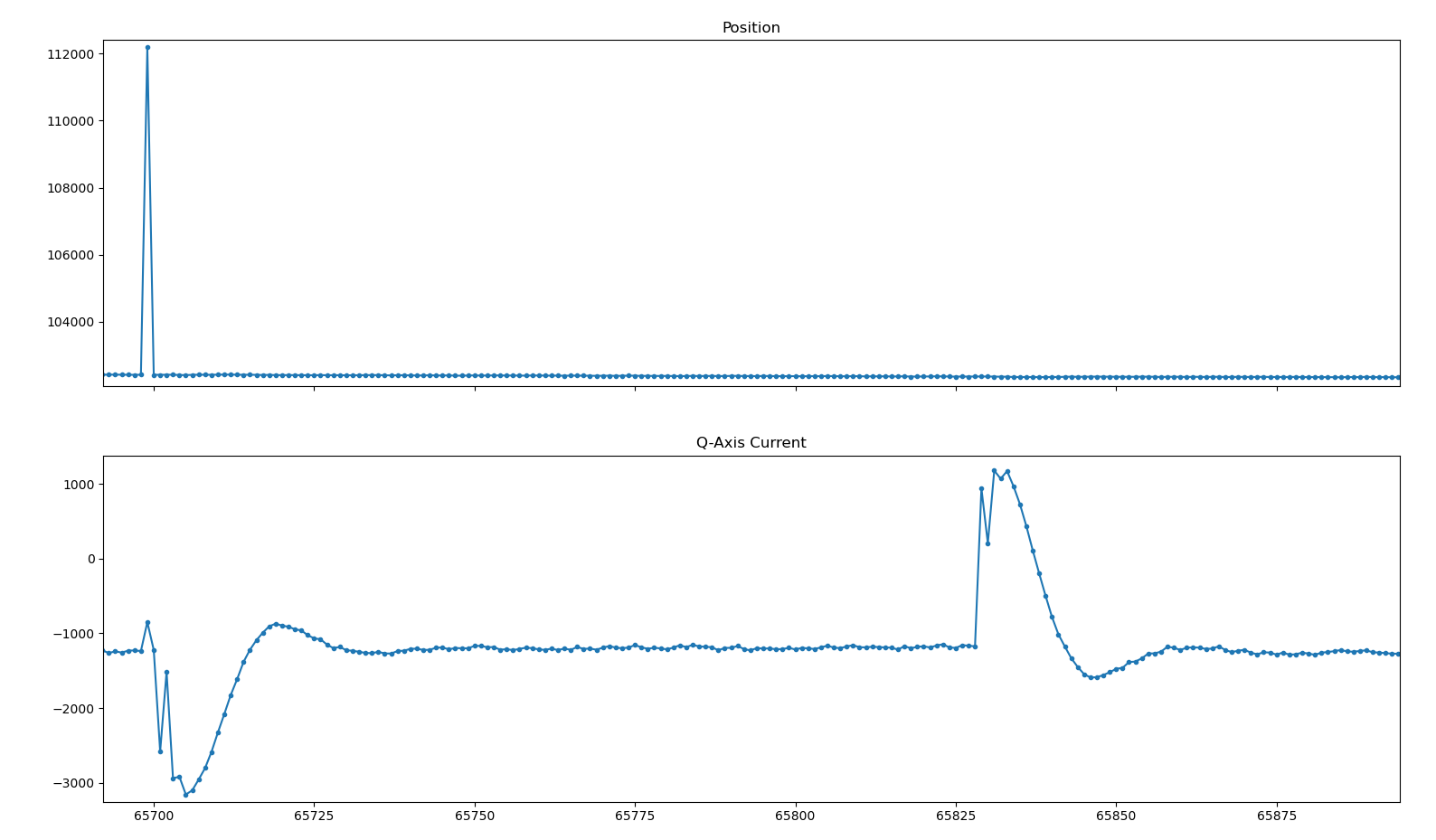
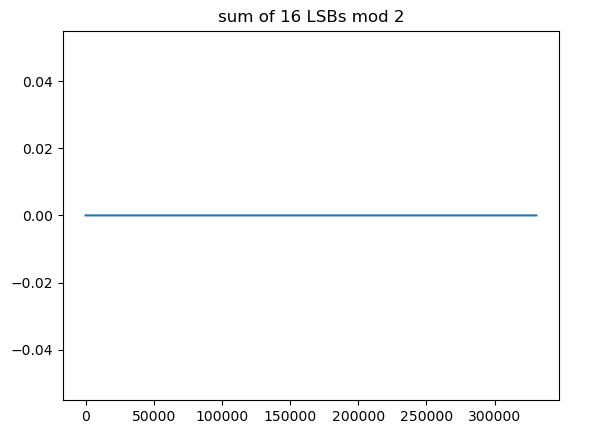
Our team is using the MA600GQE-0000 for angle and position sensing for a motor driver application. The encoder filter window is set to 0 and is being sampled at 80 kHz. The magnet being used in this application is an N42SH sintered neodymium magnet that is 6 mm in diameter and 2.5 mm in height. The air gap between the magnet and the encoder is 1.9 mm. We have set the APRT register to 1 to confirm that the reported position is not being interfered with. I am attaching some plots showing the position blip and the computed parity. Do you have any idea why the position would be blipping like this? This leads to audible clicks since our current loop uses this bad position and actually commands some current to try and correct for it.
We still saw this issue with FW = 5, but then the position blips had a sharp rise like it does now, but with a much longer decay due to the encoder filter.
The MA600A was not available when we assembled the design, and is still very difficult to procure. Is there any errata from the MA600 that is addressed by the -A part?
I would normally assume that this is a bit flip on the SPI bus caused by noise, but the fact that you see a decay when you set filter window to 5 means that the sensor is actually seeing this jump. I’m not sure what could be causing this. In your position graph above, what are the y-axis units? Are these raw encoder decimal outputs? If so, you must be using multi-turn since the max 16-bit value is 65535…?
I don’t think this is a field strength issue. Using the magnet you described (assuming on-axis placement) you are in a very nice field of around 65-70 mT.
Regarding the MA600A, the only difference is a fix in the daisy-chain mode. If you don’t use that mode, you will not see any difference between 600 and 600A.
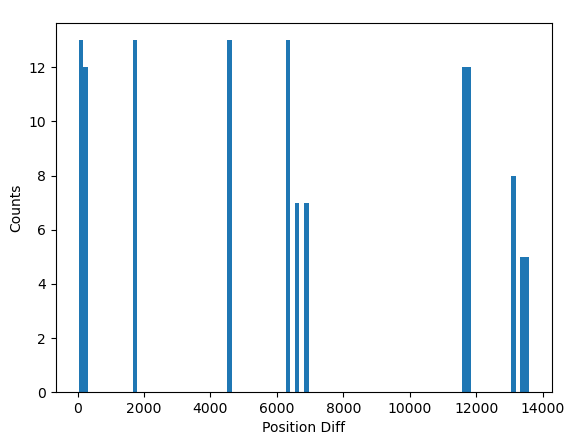
The y-axis units are position counts. Yes, we are using multi-turn. We have done a lot of analysis in the last few days to see if this could be a bit flip issue, and we are certain it is not. We have also taken a look at the distribution of “blip sizes” and it is weirdly non-uniform. Attached is a histogram of one trial we ran where we collected some data and had many occurrences of the blip.